
Here’s the Thing Many Indian organizations within the health, IT, and BPO sectors have US customers and users of health information. For organizations that serve US clients, compliance with American data privacy and information security regulations is imperative. If you’re hoping to land and keep US healthcare clients, you need to really know what it takes to get compliant. That’s why the HIPAA Certification in India is so popular today.
It is an American law (not Indian). This law was set up to protect the privacy and security of patient’s healthcare information. This law applies to all healthcare providers, health plans, clearinghouses, and any organization that maintains patient’s data on their behalf. Despite, the law being Indian, it affects Indian companies because US companies outsource work to India and also demand the same kind of protection.
What HIPAA Actually Means
The acronyms of HIPAA, the Health Insurance Portability and Accountability Act. An acte that governs how protected health information should be gathered kept released, and secured.
There are 2 rules of the law that businesses need to be aware of. The Privacy rule limits access to health information and the reason for access. The Security rule is about the technical and physical security of your electronic health information and as a business you have to restrict access, educate staff, watch your systems and be quick to respond to breaches.
For Indian companies, this means designing systems that meet US standards. It is not just about software. It is about enforcing a culture of privacy, accountability, and constant monitoring.
Why US Clients Expect It from Indian Companies
US healthcare companies have a lot to lose if their patients’ data gets exposed. The same applies to outsourcing to India. That’s why the US healthcare companies require their Indian vendors to be compliant before them signing the contract.
An US hospital, insurance company or health-tech startup will request policies, audit reports, training records and security controls. They will want to understand your data storage, access controls, breach mitigation and incident response plans. This proof is essential to capture those deals worth billions of dollars.
This expectation is mainly high for businesses in the field of: medical billing and claims processing telehealth assistance medical transcription services patient scheduling services Creation of health apps remote assistance with health services.
The Bangalore Advantage
Bangalore has grown into a key location for healthcare IT and startups and global capability centres. Numerous healthcare IT companies based in Bangalore build health-tech products for global clients as well as cater to the US healthcare segment. This has created a high demand for compliance professionals in the city.
Organizations in Bangalore that seek out the services of HIPAA certification in Bangalore are able to find highly qualified consultants, trainers, and auditors. Bangalore has a large number of IT and healthcare professionals who understand healthcare technology and requirements.
For startups in Bangalore, getting certified can be a key differentiator. It helps US clients know you take data protection seriously. It helps in engendering trust during sales calls, security reviews and vendor due diligence.
Who Needs It in India?
Every Indian company does not require HIPAA compliance. But many do. If you have to deal with patient names, medical records, insurance data prescriptions lab reports, billing data of US clients, then focus on this.
“Such as IT companies that are developing health care related applications, BPOs – looking after the medical related BPOs, KPOs – claims coding startups working on health-related apps and even digital marketing agencies working with the data of US clinics.
Position yourself to win whether a client has asked for it yet preparing in advance puts you in a better position to win. It helps you respond more quickly to proposals and pass audits without last minute panic.
Understanding the HIPAA Certification Cost
Pricing is one of the most common questions from business owners. Pricing for business security varies based on the size of the company scope company complexity, number of employees, current security posture.
Usually, when companies inquired about HIPAA certification cost in India they wanted to know just a number. On paper, cost is gap assessment, policy writing, risk assessment, employee education, technical controls audit monitoring. A single startup with a simple process will pay a lot less than a large BPO with multiple sites and hundreds of employees.
It is best to consider this cost as an investment rather than an expense. A single data breach can bring legal issues, loss of clients, and harm to your reputation. When compared to these risks, the expense of establishing proper compliance is Really lower. Reliable consultants will provide you with a clear proposal tailored to your specific needs, rather than offering a generic, one-size-fits-all package.
The Process Step by Step
Companies are often baffled at where to begin. The process is straightforward when broken down into steps.
Begin your journey to HIPAA compliance in India with a gap assessment to identify where your existing process systems have gaps. Then implement the policies necessary for privacy, security, and access control procedures, incident response, and employee training programs.
Once you have the policies in place you should put in technical and physical controls, like access controls encryption backup systems, secure networks, and monitoring systems. Next, train your staff so they understand what they should and shouldn’t be doing. Lastly, perform an internal audit and then an external review.
The certification isn’t a one and done. Policies should be reviewed on a regular basis, staff should be retrained, systems monitored, and controls should be expanded as your business grows.
Key Differences Between India and the US
Why, is that HIPAA is a law at the US federal level. While India does have data protection laws, theirs are different from what you’d find in the US. Indian companies use HIPAA because their US customers force them to, not because their law in India does.
The third is enforcement. In the US, the Department of Health and Human Services is the regulator, able to investigate and levy fines. In India, enforcement is through clients’ contracts, audits, and businesses’ loss. If you fail an audit, you may lose a client even if no Indian authority hits you with a fine.
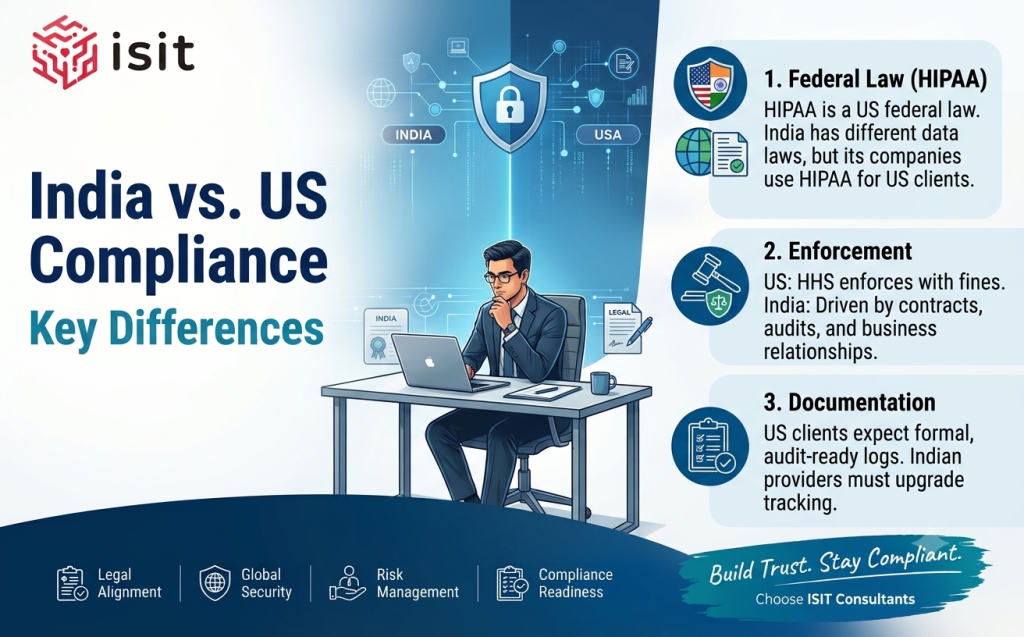
Also, documentation standards may vary. US customers require formal, audit-ready documentation. Many Indian providers, who are used to informality, will need to update access records and logging and track incident reports.
Common Mistakes Indian Companies Make
One frequent misconception is that HIPAA concerns only IT. In fact, it encompasses HR, operations, legal, and management as well. Every employee who handles patient data needs to be trained and monitored so.
Third, copying policies from the internet. US auditors and clients can tell when a policy is generic. Your policies should accurately describe your processes and the tools you use, as well as your team.
Many organizations consider certification to be a one-time validation to their customers. Unfortunately, during audits, this approach can backfire. True compliance is not a destination; it’s a journey of continuous effort, assessment, and security culture.
How to Choose the Right HIPAA Consultant
The right partner Matters. Find managers who can advise based on your requirements. Who have worked with US healthcare customers, who comprehend both HIPAA and the Indian business climate, and can support from assessment to audit.
Request case studies, sample policies, timelines, and get to the bottom of what they will deliver. An expert consultant will give you way more than documents: they will work with your team, show you how to put controls into place, and coach you for audit.
Steer clear of consultants who guarantee you quick Certification with no assessment or training. True compliance takes time, but it will be worth it to your business.
Key Takeaways for Business Owners
- Understand how HIPAA applies to Indian companies handling US healthcare data.
- Identify whether your business qualifies as a HIPAA business associate.
- Protect patient information through proper data security measures.
- Train employees on healthcare data privacy and security practices.
- Implement access controls, data encryption, and regular security checks.
- Maintain proper documentation, policies, and compliance records.
- Choose an experienced HIPAA consultant to support your compliance journey.
- Build trust with US healthcare clients through strong data protection practices.
Conclusion
Sure, HIPAA is a law in the US, but its changes are also very much a requirement for Indian companies. If you are an IT company BPO healthcare startup, or service provider, having a solid understanding of HIPAA controls can help you access top-tier clients in the US. Not only does it mean you have a way to build trust and security, but it also can help you put processes in place to keep your operations secure long-term. The place to start is by assessing where you are, getting your policies in place, training your people, and keeping them compliant. If you’re ready to learn, how to get HIPAA certification in India is the answer to everything you need to understand to get there. Explore HIPAA certification benefits, cost, requirements and more in India with ISIT Consultants today.

